Martian dust is gentler than lunar dust, but it has risks
Spacesuit samples aboard Perseverance barely wore down over 1,645 Martian days.
Spacesuit samples traveling with the Perseverance rover show that Martian dust does not scratch like lunar dust, although it hides other dangers.
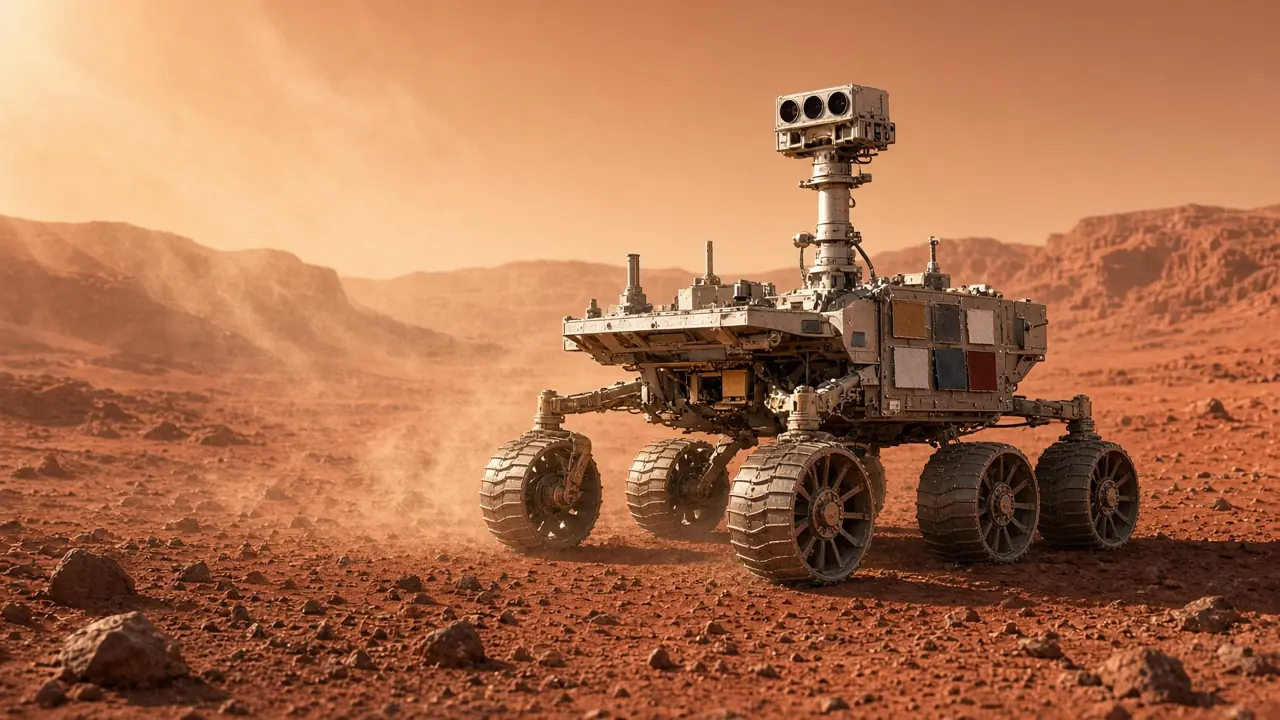
The Perseverance rover carries small samples of spacesuit materials to study how the Martian environment affects them. A study in PNAS, with participation from Washington University in St. Louis, analyzed the dust accumulated on them after 1,645 Martian days.
The grains are rounded, like river pebbles, because wind has made them collide with each other for a long time. That makes them less abrasive than lunar dust, which scratched visors and damaged suits during the Apollo missions. The samples showed barely any visible wear.
But there is a problem: part of the dust is fine and ultrafine, with particles of just 100 nanometers that cling to fabrics through static electricity. That size would allow them to reach deep into the lungs and even the blood. In addition, the PIXL instrument detected perchlorates, sulfur, iron and silica, potentially toxic compounds.
The samples, including Teflon and Vectran, are mounted on the calibration target of the SHERLOC instrument. According to JPL, electrostatic charge seems to determine which particle sizes stick to each material, and fine dust persists even when the rover moves or drills.
Key facts
- Samples analyzed after 1,645 Martian days.
- Particles of about 100 nanometers that stick through static.
- PIXL detected perchlorates, sulfur, iron and silica.
- Lunar dust, by contrast, scratched visors on the Apollo missions.
The results will help design suits and protocols to protect future crews on Mars.
Futurismo newsletter
Get the most futuristic stories in your inbox. Free.
By subscribing you agree to receive emails from Futurismo and our privacy policy. Unsubscribe anytime.Related stories
The five letters of the genetic code were on asteroid Ryugu
Samples brought back by Japan's Hayabusa2 mission contain all five bases of DNA and RNA.
A nasal spray reduces tau protein in mice with dementia
A single dose improved memory in old mice, according to a UTMB study.

The battery that stores energy with CO2 instead of lithium
An Italian company stores solar electricity by compressing carbon dioxide.
The star cluster that is almost as old as the universe
A cluster hidden behind the dust of the galactic center may be 13.4 billion years old.