The secret of self-healing Roman concrete
MIT found that hot-mixed quicklime seals cracks on its own.
Some Roman structures are still standing after 2,000 years. An MIT study explained part of the secret: their concrete heals itself.
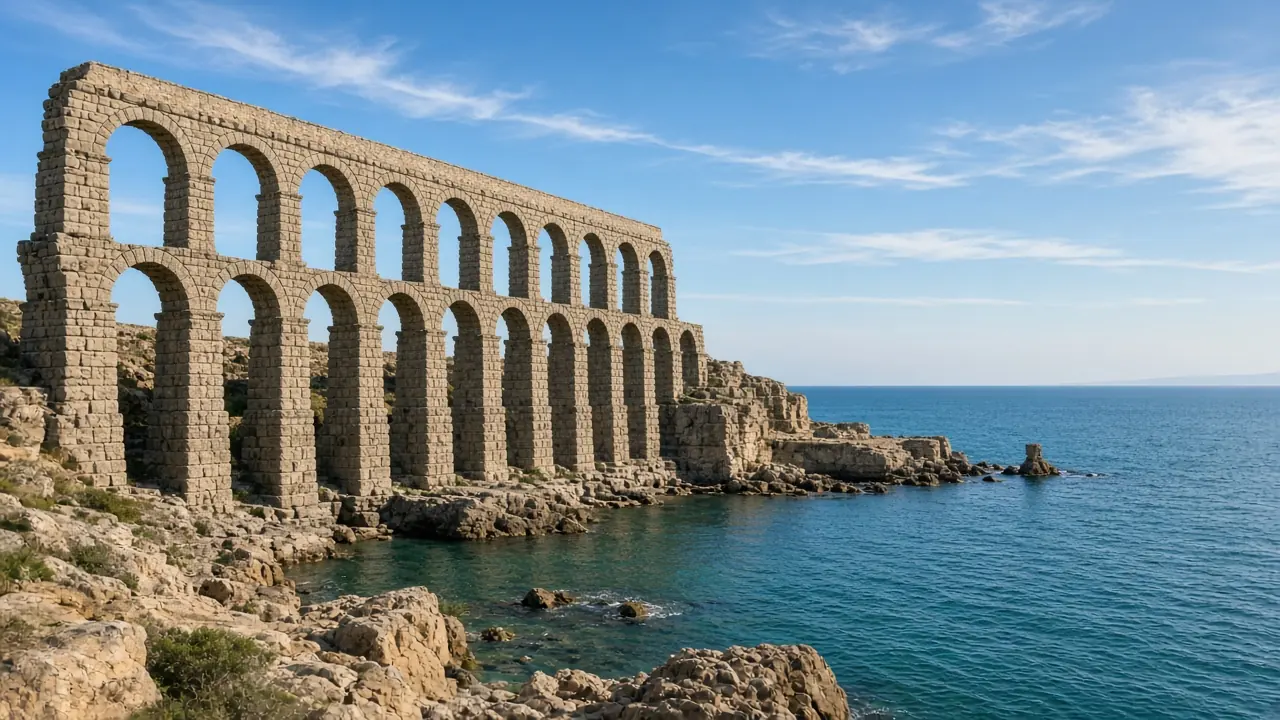
For a long time, the small white lumps of lime found in Roman concrete were thought to be a sign of sloppy mixing. A team at the Massachusetts Institute of Technology (MIT) showed in 2023 that they were key to its durability.
The Romans likely used "hot mixing": combining quicklime, instead of slaked lime, with the other materials. The reaction generates heat and leaves those calcium-rich lumps. When a crack appears and water gets in, the calcium dissolves and recrystallizes as calcium carbonate, sealing the fissure.
The team tested it in the lab: they made concrete with this method, cracked it and let water run through. Within two weeks the cracks had fully sealed and the water stopped flowing, while concrete without quicklime did not heal. This could inspire longer-lasting materials with a smaller environmental footprint.
The team, led by Admir Masic and Linda Seymour, analyzed 2,000-year-old samples from the city wall of Privernum, an ancient town near Rome. Using electron microscopy, X-ray diffraction and Raman imaging, they confirmed the lumps were forms of calcium carbonate formed at high temperatures. According to Masic, hot mixing has two advantages: it enables chemical reactions impossible with slaked lime and speeds up setting, allowing faster construction. In the paper, the modern Roman-inspired material sealed cracks up to 0.5 millimeters wide.
Key facts
- Key technique: hot mixing with quicklime.
- The lime lumps act as a calcium reservoir.
- Cracks sealed by recrystallized calcium carbonate.
- MIT study published in January 2023 in Science Advances.
- Samples from the Privernum city wall, near Rome.
The researchers aim to bring this technique to modern concrete.
Futurismo newsletter
Get the most futuristic stories in your inbox. Free.
By subscribing you agree to receive emails from Futurismo and our privacy policy. Unsubscribe anytime.Related stories

Living microbes found inside a 2-billion-year-old rock
It is the oldest known rock hosting life, sealed in clay-filled cracks.
An AI-agent lab that runs DNA experiments on its own
AutoDNA, in Shanghai, designs and executes molecular experiments with minimal human intervention.
Scientists confirm a third type of magnetism
Altermagnetism combines antiferromagnet-like stability with spin currents useful for electronics.
An algorithm uncovers a hidden planet in JWST data
FLIP boosts sensitivity up to 15 times by removing star glare and recovers 51 Eridani b.