K2-18b: the signs of life that still don't convince
James Webb hinted at molecules linked to life, but later reanalyses don't confirm them.
In 2025, a Cambridge team announced the "strongest hints" of biological activity outside the solar system. The evidence, however, remains far from conclusive.
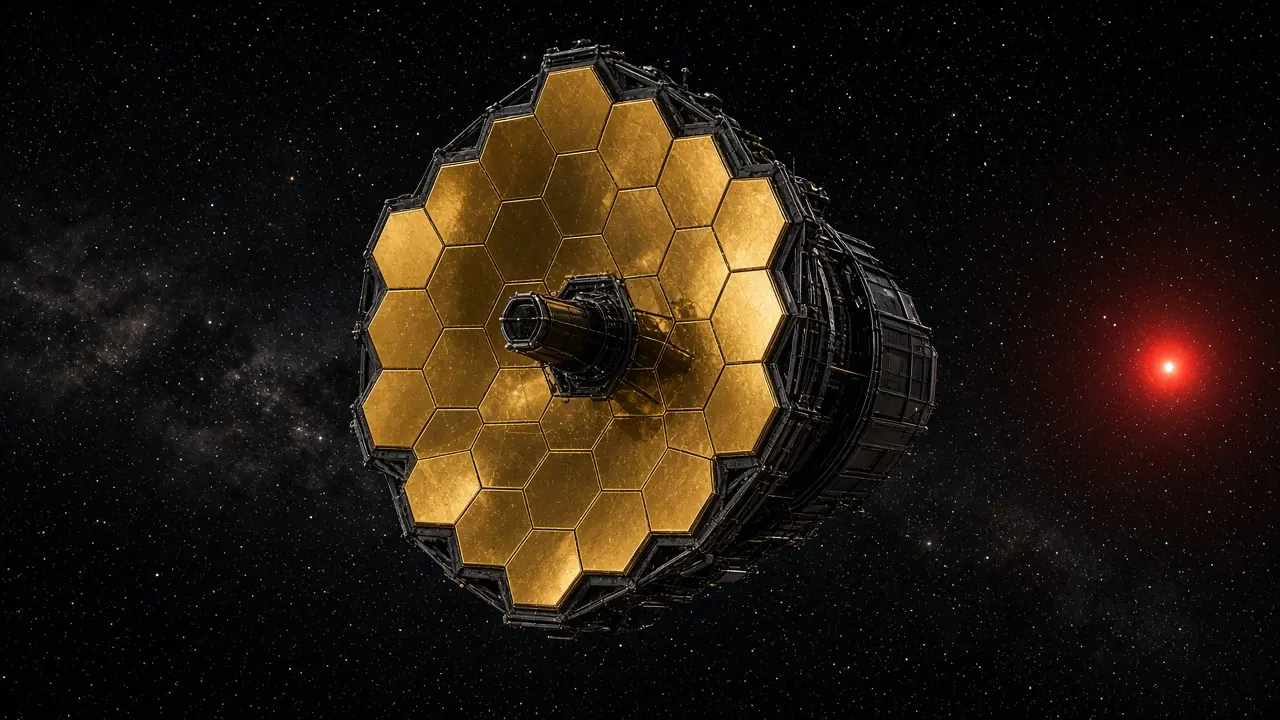
K2-18b is an exoplanet about 124 light-years away, larger than Earth, which could have an ocean beneath a hydrogen-rich atmosphere. A team led by Nikku Madhusudhan, of the University of Cambridge, analyzed observations from the James Webb Space Telescope's MIRI instrument.
They detected signals consistent with dimethyl sulfide (DMS) or dimethyl disulfide (DMDS), compounds that on Earth are mostly produced by living organisms such as marine phytoplankton. The estimated concentrations exceeded 10 parts per million, thousands of times more than on Earth. The statistical significance was about 3 sigma, below the 5 sigma required to claim a discovery.
The authors themselves said it was not proof of life and that unknown non-biological processes might be involved. Later, other teams reanalyzed the data, for example in studies arXiv 2505.13407 and 2508.05961, and found no significant detection. The real status today is this: there is a weak, disputed signal, not a confirmation.
K2-18b has 8.6 times Earth's mass and 2.6 times its size, and orbits in the habitable zone of a red dwarf star in the constellation Leo. A 3-sigma signal implies a 0.3% chance of being a fluke; a discovery requires less than 0.00006%.
Key facts
- DMS/DMDS signal at about 3 sigma; 5 are required to confirm.
- Estimated concentration above 10 ppmv.
- Data from the James Webb telescope's MIRI instrument.
- Independent reanalyses found no significant detection.
More Webb observing time will be needed to confirm or rule out the signal.
Futurismo newsletter
Get the most futuristic stories in your inbox. Free.
By subscribing you agree to receive emails from Futurismo and our privacy policy. Unsubscribe anytime.Related stories
An algorithm uncovers a hidden planet in JWST data
FLIP boosts sensitivity up to 15 times by removing star glare and recovers 51 Eridani b.
A hidden star is plowing through Betelgeuse's atmosphere
Radio telescopes detect that a companion called Siwarha is distorting the red supergiant's atmosphere.
Mars is not dead: a giant volcano is still exhaling gas
The Trace Gas Orbiter detects hydrogen chloride over Alba Mons, a sign of ongoing igneous processes.
Hubble finds that oxygen is missing from dwarf galaxies
Supernova explosions expel more oxygen from small galaxies than models predicted.