A hidden star is plowing through Betelgeuse's atmosphere
Radio telescopes detect that a companion called Siwarha is distorting the red supergiant's atmosphere.
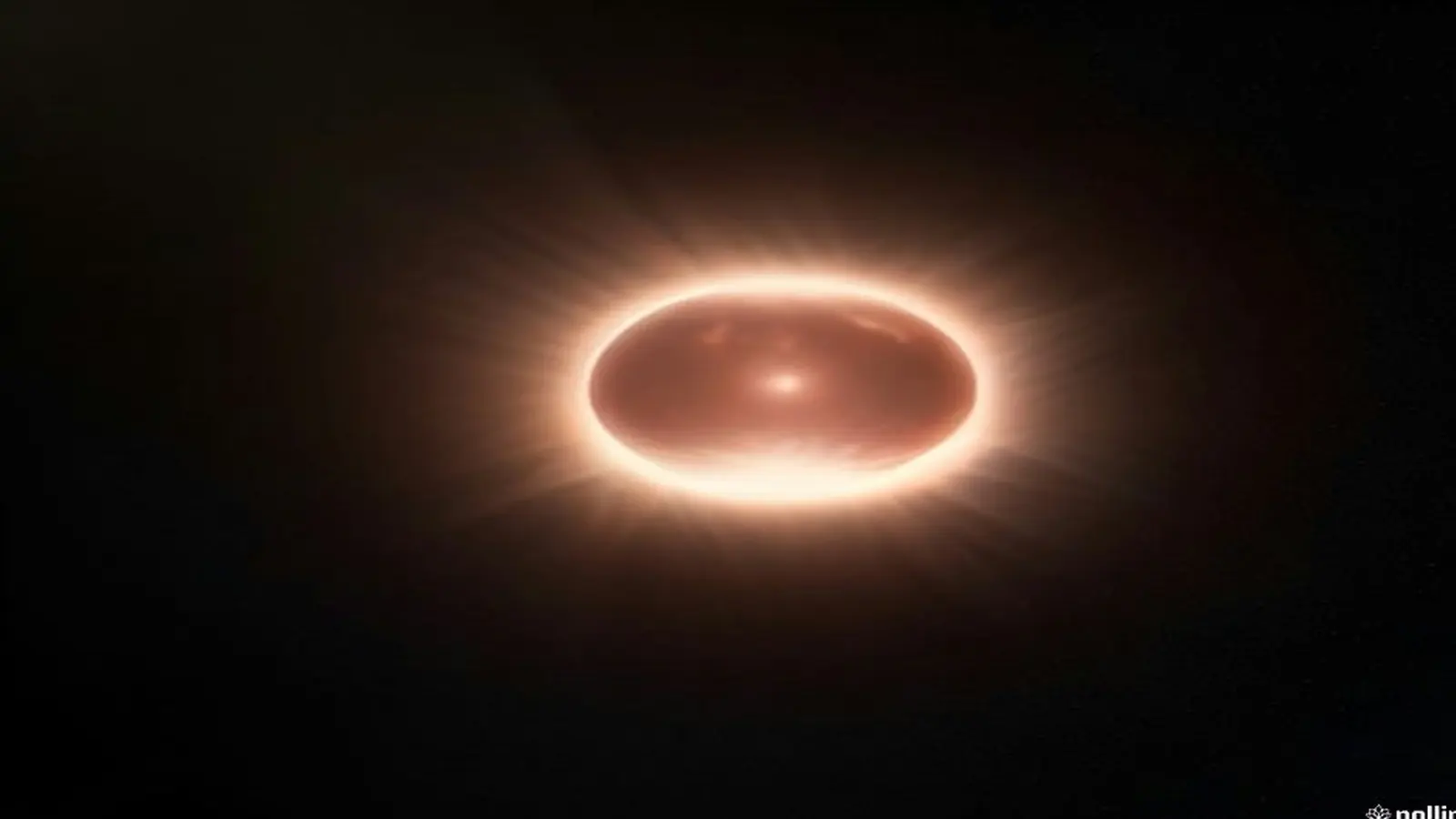
Something is moving inside the enormous atmosphere of Betelgeuse, Orion's shoulder. Astronomers believe it is a companion star cutting through it like a boat through water.

A team led by Lynn D. Matthews, of MIT's Haystack Observatory, found new evidence that Siwarha, a companion star proposed in 2024, travels through Betelgeuse's extended atmosphere. The study was published in The Astronomical Journal.
The researchers combined observations from the VLA and ALMA radio telescopes made between 2021 and 2026 at seven frequencies, from 22 to 485 GHz, to reconstruct the star's outer layers. Siwarha is too faint to be seen in radio, but it left a mark: the atmosphere looks more elongated when the companion is at its greatest apparent separation and rounder when it passes in front of or behind the star.
The data also show that the atmosphere has recovered from the Great Dimming of 2019-2020, when Betelgeuse fell to its lowest brightness in more than a century. They also confirmed an unexpectedly cold layer of gas, about 2,200 kelvin, more than a thousand degrees below its visible surface.
Key facts
- Siwarha would orbit at only about twice Betelgeuse's radius.
- It was proposed to explain a brightness cycle of about 2,100 days.
- At 2.7 stellar radii, the gas is now around 3,500 kelvin.
- Siwarha means "her bracelet" in Arabic.
The authors call for observing more of the orbit to confirm it, and the future ngVLA radio telescope could provide the definitive picture.
Futurismo newsletter
Get the most futuristic stories in your inbox. Free.
By subscribing you agree to receive emails from Futurismo and our privacy policy. Unsubscribe anytime.Related stories
An algorithm uncovers a hidden planet in JWST data
FLIP boosts sensitivity up to 15 times by removing star glare and recovers 51 Eridani b.
K2-18b: the signs of life that still don't convince
James Webb hinted at molecules linked to life, but later reanalyses don't confirm them.
Hubble finds that oxygen is missing from dwarf galaxies
Supernova explosions expel more oxygen from small galaxies than models predicted.
The Swift telescope will fall to Earth after a failed rescue
After almost 22 years hunting cosmic explosions, the NASA observatory is reentering the atmosphere uncontrolled.