Homo erectus fossils recovered from the seafloor in Indonesia
Remains dredged from the Madura Strait reveal a land now underwater.
Beneath the sea between Java and Madura there was a plain inhabited by Homo erectus. Two skull fragments dredged from the seabed prove it.
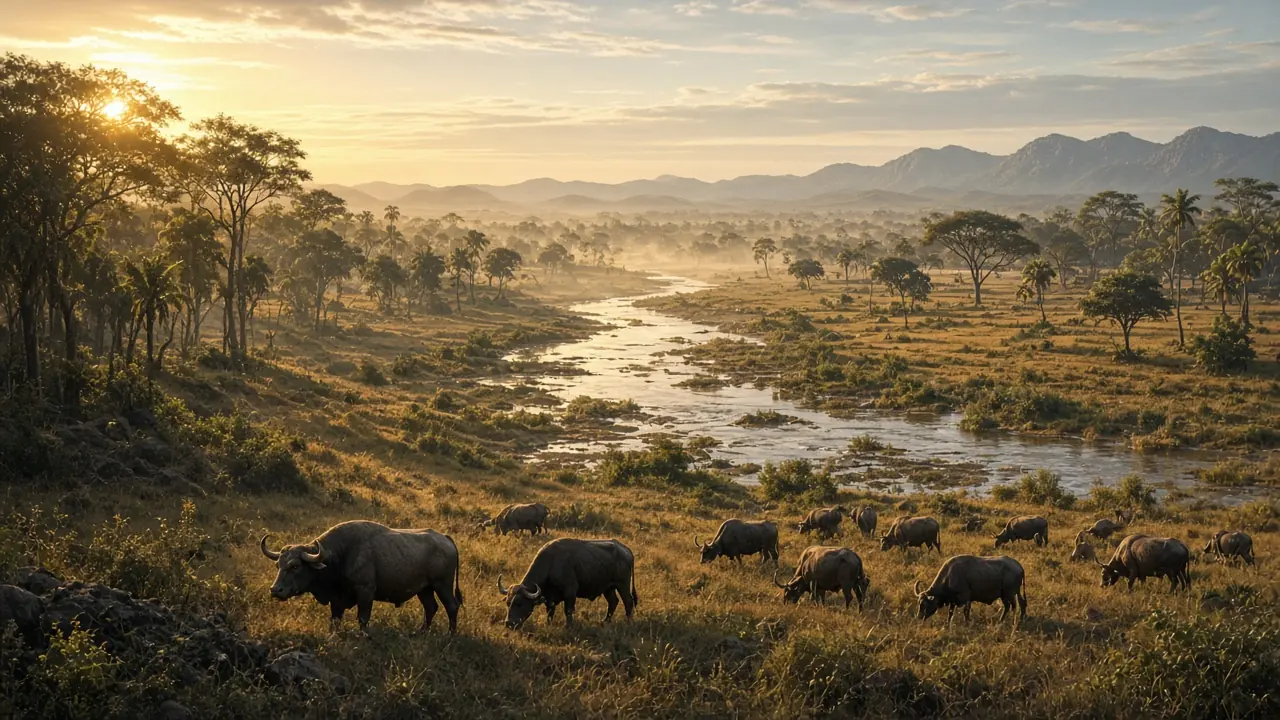
During dredging works in the Madura Strait, in Indonesia, sediments with thousands of animal fossils and two Homo erectus skull fragments came to light. A team led by Harold Berghuis, of Leiden University, studied them and published in Quaternary Environments and Humans in 2025.
The remains come from an ancient valley of the Solo River, now submerged, that was dry land between 146,000 and 131,000 years ago, when sea level was lower and Java was part of the Sundaland landmass.
The animal bones show cut marks revealing behaviors: Homo erectus hunted prime-age bovids, broke bones to extract marrow and also exploited turtles. These behaviors have been compared with those of more modern humans in mainland Asia.
The remains surfaced thanks to a 2014-2015 project: dredging about 5 million cubic meters of sediment to build an artificial island. Later searches gathered 6,732 vertebrate fossils, including Komodo dragon remains. They are the first human fossils found in submerged Sundaland.
Key facts
- Two Homo erectus skull fragments.
- Age: 146,000 to 131,000 years.
- Cut marks on bovid and turtle bones.
- Leiden University study, 2025.
- 6,732 vertebrate fossils were collected.
The find opens the door to searching for more remains in the landscapes now covered by the sea in Southeast Asia.
Futurismo newsletter
Get the most futuristic stories in your inbox. Free.
By subscribing you agree to receive emails from Futurismo and our privacy policy. Unsubscribe anytime.Related stories
An AI-agent lab that runs DNA experiments on its own
AutoDNA, in Shanghai, designs and executes molecular experiments with minimal human intervention.
Neuralink now has 21 people controlling computers with their minds
Two years after its first implant, the Telepathy chip is adding patients in four countries.
An AI designs proteins from a simple text description
The Pinal model turns a sentence into a candidate protein, although its hit rate is still uneven.
Scientists turn colon cancer cells into near-normal cells
A KAIST team managed to "reverse" cancer in the lab without killing the cells.