An AI designs proteins from a simple text description
The Pinal model turns a sentence into a candidate protein, although its hit rate is still uneven.
Type "I want a protein that glows green" and get a design ready to test. That is the promise of a new artificial intelligence.
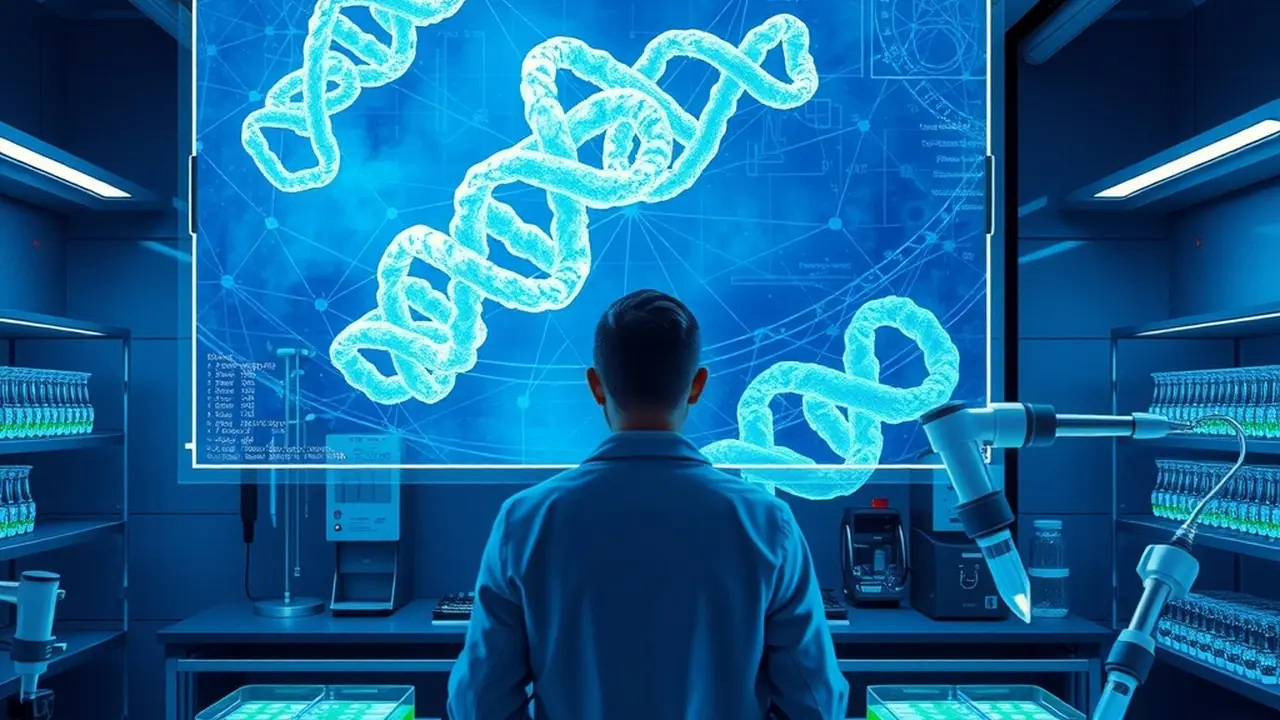
A team led by Westlake University, in China, presented Pinal in the journal Nature, a large AI model that generates candidate proteins from natural-language instructions alone, without the user having to master molecular structures or geometric constraints.
Pinal works in two steps. Its first module, T2struct, turns the description into a structural blueprint; the second, SaProt-T, uses that blueprint and the original text to write the amino acid sequence. It generates several blueprints, designs the best sequence for each and picks the highest-scoring pair. To train it, the team started from 135 million sequences and built a library of 1.7 billion protein-text pairs, with predicted structures from the AlphaFold database.
The results were mixed. For the fluorescent protein it created 50,000 sequences; 29 were tested and only one glowed. It did better with a metabolic H-protein: five of twenty candidates worked, and the best one boosted the output of a key carbon-capture process 1.7 times compared with the natural E. coli protein.
Key facts
- It was tested on four proteins, including a plastic-degrading enzyme.
- Training library: 1.7 billion protein-text pairs.
- It is still hard to ask it for precise properties, such as an exact emission color.
- Published in Nature.
More work is still needed before Pinal becomes a routine tool in laboratories.
Futurismo newsletter
Get the most futuristic stories in your inbox. Free.
By subscribing you agree to receive emails from Futurismo and our privacy policy. Unsubscribe anytime.Related stories

An AI-agent lab that runs DNA experiments on its own
AutoDNA, in Shanghai, designs and executes molecular experiments with minimal human intervention.
Scientists turn colon cancer cells into near-normal cells
A KAIST team managed to "reverse" cancer in the lab without killing the cells.

Homo erectus fossils recovered from the seafloor in Indonesia
Remains dredged from the Madura Strait reveal a land now underwater.
Neuralink now has 21 people controlling computers with their minds
Two years after its first implant, the Telepathy chip is adding patients in four countries.