Wood slices that filter nanoparticles from water
Thin cuts of wood retained up to 99.9% of test particles in the lab.
A simple slice of wood could become a natural filter to trap tiny particles from water.
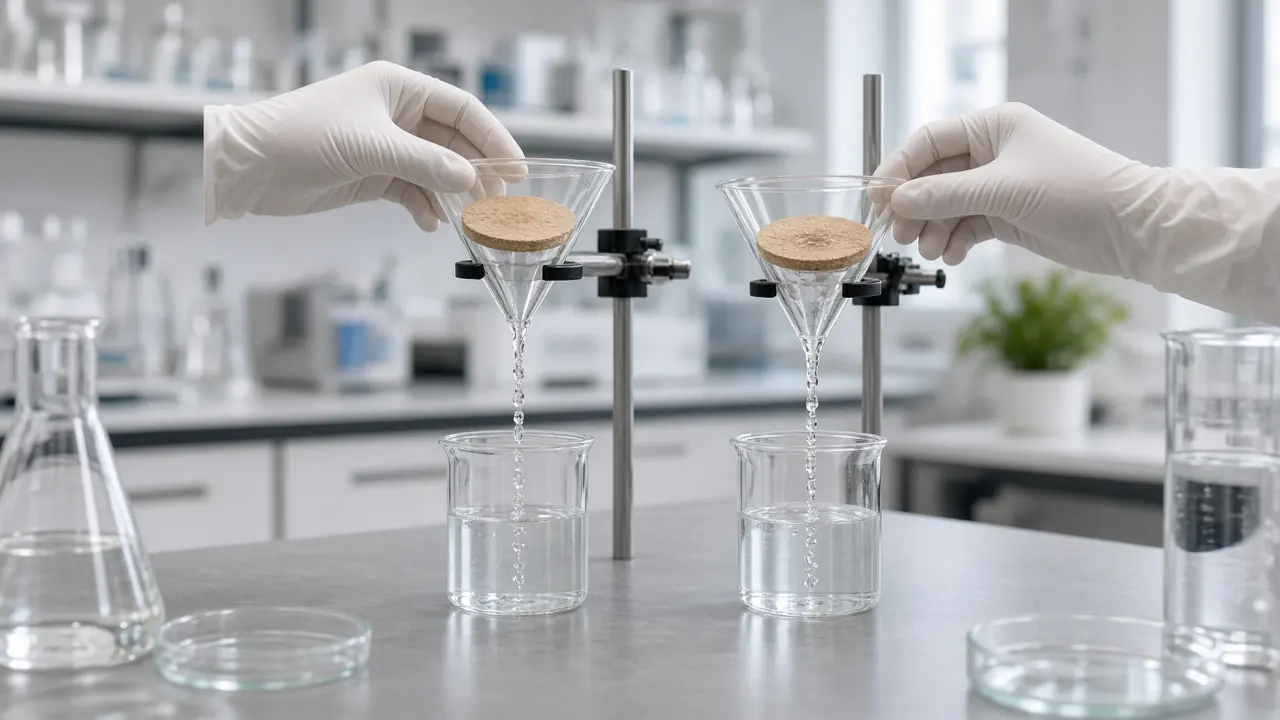
A study published in the journal Wood Science and Technology in 2025 tested the ability of thin slices of wood to filter water. The idea takes advantage of the natural channels trees use to carry sap.
The researchers passed water containing tracer nanoparticles through the slices and measured how many were retained. Depending on the type of wood, between 99.3% and 99.9% of the tracers were removed. Beech wood was the preferred option for its performance.
It is a promising result for developing cheap, sustainable filters. But caution is needed: these are lab tests with model particles, not a household filter proven on real contaminated water.
The slices were 1 millimeter thick and 50 millimeters in diameter. Iron oxide nanoparticles of 506 nanometers were used as tracers. Beech retained 99.9% in the radial direction and 99.7% in the tangential direction, and silver fir between 99.3% and 99.7%. Beech was preferred because it let more water through. The effective size-exclusion range was about 160 to 490 nanometers, depending on cut orientation.
Key facts
- Tracer nanoparticle retention: 99.3% to 99.9%.
- Beech wood was preferred.
- Published in Wood Science and Technology in 2025.
- It is not yet a proven household filter.
- Slices 1 mm thick and 50 mm in diameter.
Its effectiveness with real water, bacteria and contaminants still needs testing before any practical use.
Futurismo newsletter
Get the most futuristic stories in your inbox. Free.
By subscribing you agree to receive emails from Futurismo and our privacy policy. Unsubscribe anytime.Related stories

Europa's oceans could host long-lived hydrothermal vents
A model shows seafloor heat could last billions of years.

Martian dust is gentler than lunar dust, but it has risks
Spacesuit samples aboard Perseverance barely wore down over 1,645 Martian days.
A nasal spray reduces tau protein in mice with dementia
A single dose improved memory in old mice, according to a UTMB study.

Scientists confirm a third type of magnetism
Altermagnetism combines antiferromagnet-like stability with spin currents useful for electronics.