The coldest temperature ever measured is born in orbit
On Tiangong station, rubidium atoms reached 9.7 picokelvin, four times colder than the previous record.
Just ten trillionths of a degree above absolute zero. That is the new cold record, and it was not set in a ground lab: it was measured in space.
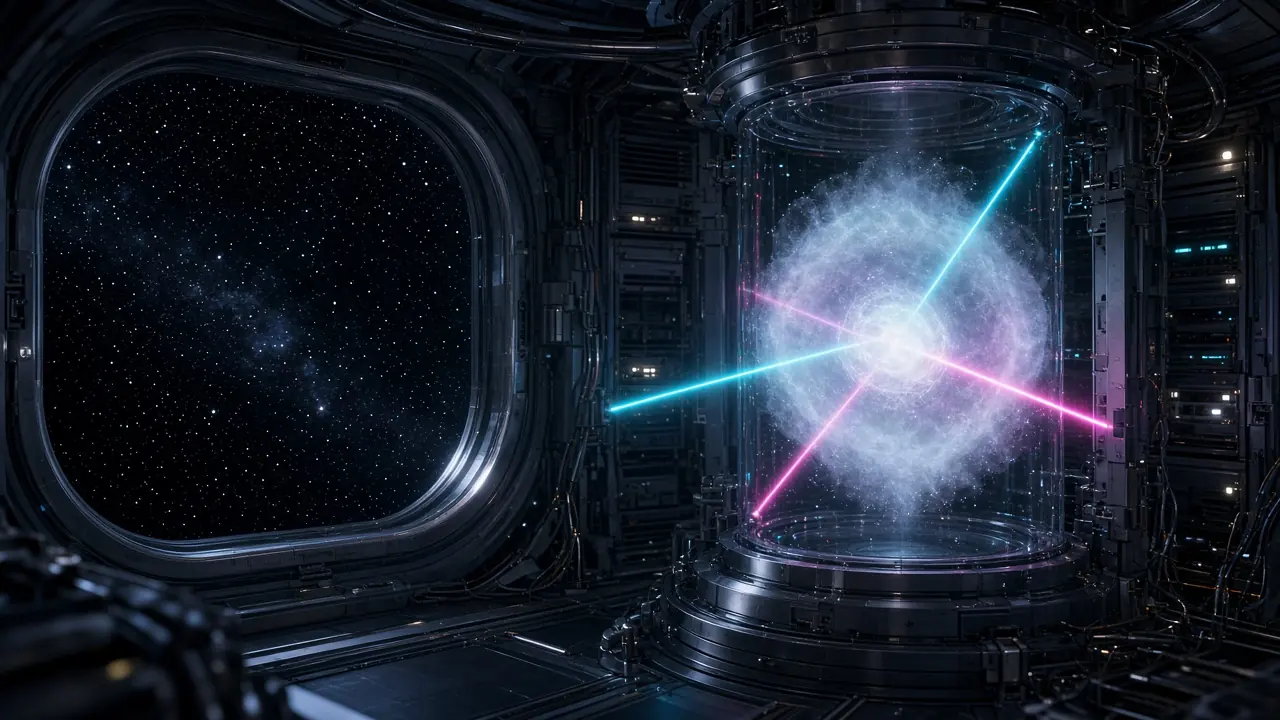
Chinese physicists reported on November 5, 2026 in Science the result from the Cold Atom Physics Rack (CAPR) aboard the Tiangong space station. There they created a rubidium Bose-Einstein condensate at about 9.7 picokelvin. The previous record, also in microgravity, was around 52 picokelvin in NASA’s Cold Atom Laboratory on the International Space Station.
CAPR uses two nested optical dipole traps formed by intense crossing lasers, rather than a magnetic atom chip. First they trapped about two million atoms; lowering the power let the more energetic ones escape, leaving about 2,000 at 3 nanokelvin. Then they let the gas expand into a wider trap: as it dilutes, interaction energy falls and the effective temperature drops. The atoms move at less than 200 micrometers per second.
In zero gravity, after releasing the cloud, the team could track its expansion for about 7 seconds, ideal for atom interferometry that tests whether gravity pulls equally on all atom types, as general relativity assumes. Next come optical lattices to simulate materials, even phenomena akin to high-temperature superconductivity, with less noise thanks to the extreme cold.
Key facts
- Record temperature: about 9.7 picokelvin (published in Science, Nov 5, 2026).
- Rubidium Bose-Einstein condensate aboard Tiangong (CAPR).
- Free expansion observed for about 7 seconds in microgravity.
- The module is open to international collaborations, the team says.
Extreme cold in space is not just a record: it is a platform to measure gravity and simulate matter in conditions Earth cannot offer.
Futurismo newsletter
Get the most futuristic stories in your inbox. Free.
By subscribing you agree to receive emails from Futurismo and our privacy policy. Unsubscribe anytime.Related stories
A theorem strengthens the case that the universe had a beginning
Raphael Bousso extends a singularity theorem into the quantum realm.

The battery that stores energy with CO2 instead of lithium
An Italian company stores solar electricity by compressing carbon dioxide.
Skyscrapers that work as gravity batteries
Energy Vault and SOM propose storing energy by raising and lowering weights inside towers.

Scientists create a supersolid of light and matter at room temperature
A quantum state that flows like a liquid and orders itself like a crystal, with no need for extreme cold.