The world's oldest computer tracked the lunar calendar
Gravitational-wave techniques solve a riddle of the Antikythera mechanism.
Techniques built to hunt gravitational waves have just solved a 2,000-year-old riddle: how many holes a ring of the Antikythera mechanism had.
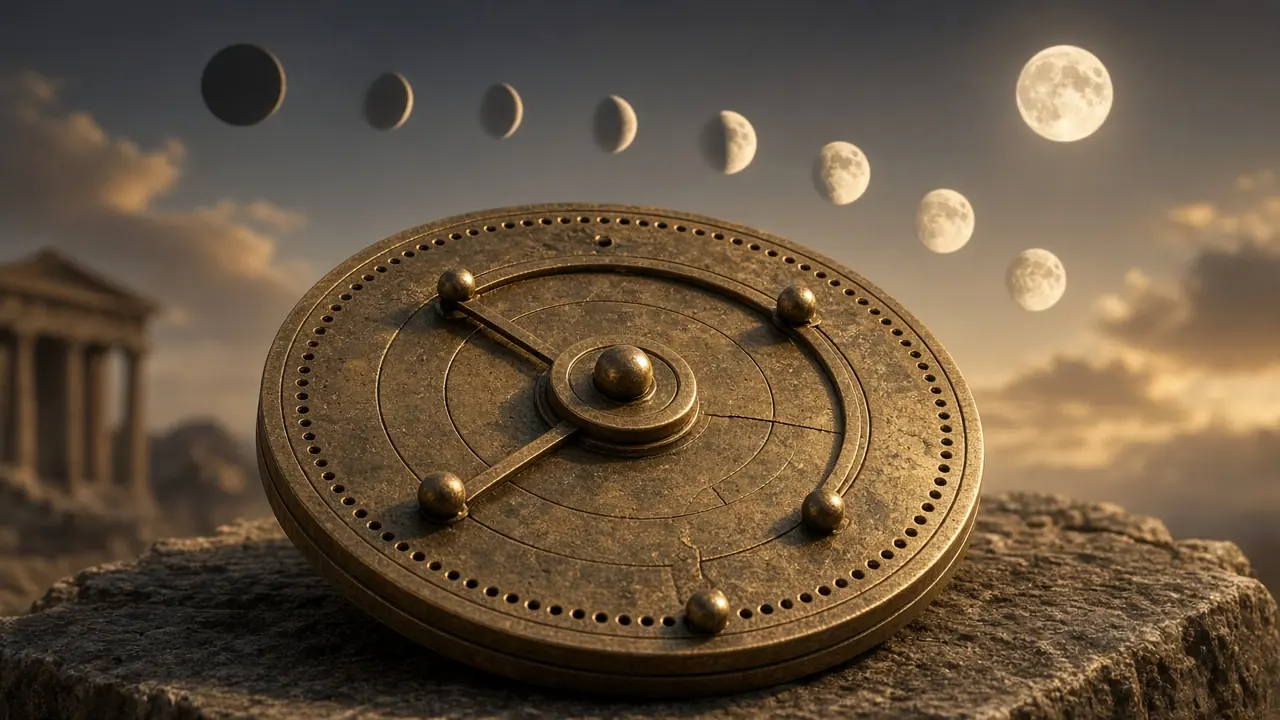
The Antikythera mechanism is a Greek artifact from the 2nd century BC, found in 1901 by divers in a shipwreck near the island of the same name, in the Aegean Sea. It worked as a hand-powered analog computer: with gears and dials it could predict eclipses and calculate the positions of the planets on any date.
In 2020, new X-rays of its calendar ring revealed a series of regularly spaced holes. But the ring is broken and incomplete, and initial estimates ranged from 347 to 367 holes. Graham Woan and Joseph Bayley, of the University of Glasgow, applied Bayesian analysis and statistical methods their group uses with the LIGO detectors, based on the positions of the surviving holes and six fragments of the ring.
The result: the ring almost certainly had 354 or 355 holes, matching the Greek lunar year, not 365 like the Egyptian calendar. The figure of 354 turned out hundreds of times more likely than 360, proposed in earlier studies. The analysis also revealed astonishing manufacturing precision, which would have required very accurate measuring techniques and an extraordinarily steady hand.
Key facts
- The ring had a radius of 77.1 mm, with an uncertainty of a third of a millimeter.
- The average radial variation between holes was only 0.028 mm.
- The work started from data gathered by YouTuber Chris Budiselic to build a replica.
- Published in the Horological Journal on June 27, 2024.
The authors hope the finding will help explain how this unique device was made and used.
Futurismo newsletter
Get the most futuristic stories in your inbox. Free.
By subscribing you agree to receive emails from Futurismo and our privacy policy. Unsubscribe anytime.Related stories

A hidden star is plowing through Betelgeuse's atmosphere
Radio telescopes detect that a companion called Siwarha is distorting the red supergiant's atmosphere.
An algorithm uncovers a hidden planet in JWST data
FLIP boosts sensitivity up to 15 times by removing star glare and recovers 51 Eridani b.
A theorem strengthens the case that the universe had a beginning
Raphael Bousso extends a singularity theorem into the quantum realm.
The Swift telescope will fall to Earth after a failed rescue
After almost 22 years hunting cosmic explosions, the NASA observatory is reentering the atmosphere uncontrolled.