A moth robot grows a sensor from its own blood
Tartu and IIT engineers make a 3D-printed robot fabricate a UV detector wherever light shines.
Robots usually leave the factory with every sensor they will ever have. This one grows a new one when needed, using chemicals that circulate through its wings.
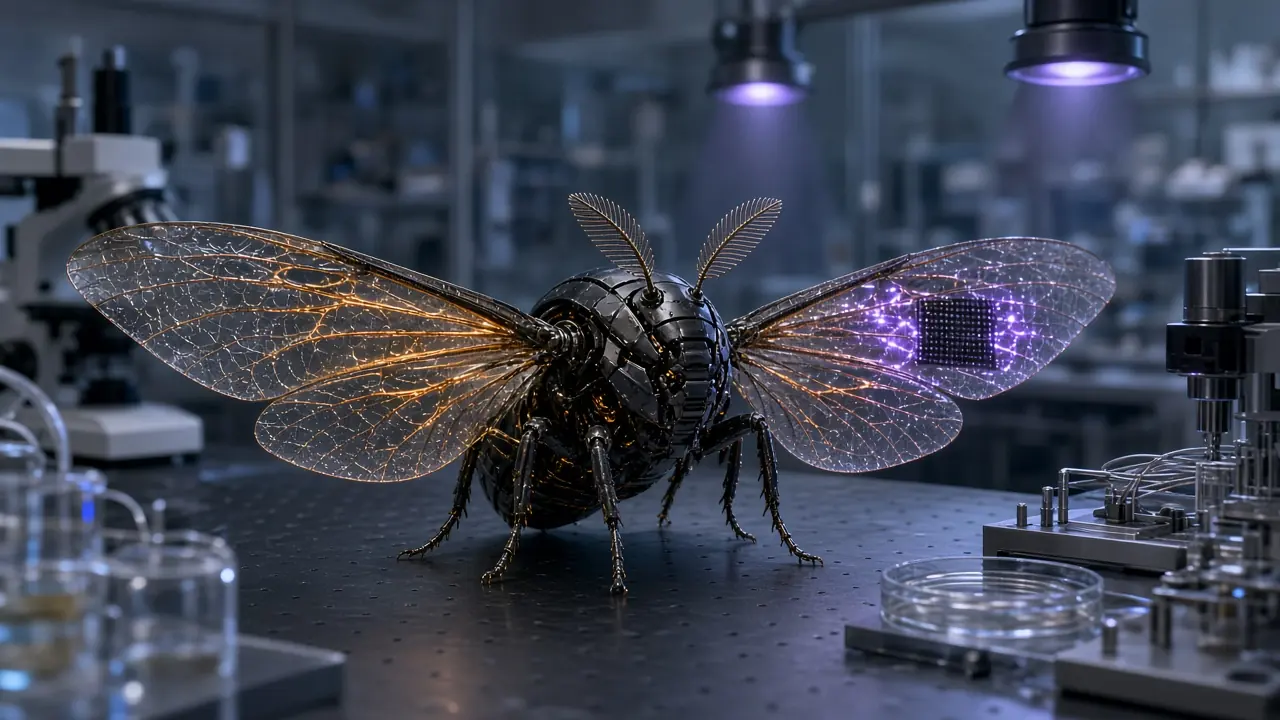
Researchers at the University of Tartu (Estonia) and the Italian Institute of Technology presented a moth-shaped robot whose transparent body is laced with microscopic veins. A pump circulates about 3 milliliters of artificial “blood” carrying pyrrole. When a wing patch is lit with ultraviolet light and a photoinitiator, the pyrrole polymerizes into conductive polypyrrole. The work appeared in Advanced Science and was covered by New Atlas on November 5, 2026.
Gold wires printed with the body read the electrical change. When a UV flash hits, the patch’s resistance drops briefly and a chip lights an LED or flaps the wings with a nitinol wire. The sensor still worked after four months in storage and grew more sensitive with each exposure. The team chooses where the receptor grows with a stencil; the robot does not yet decide on its own.
It cannot fly, and the wings move with external power, but the idea points to missions where no one knows in advance what must be detected: collapsed buildings or other planets. In the future, the same circulation could power the processor or swap chemicals according to the environment.
Key facts
- Published in Advanced Science; Tartu and IIT teams.
- About 3 ml of fluid with pyrrole forms polypyrrole under UV.
- The UV sensor still responded after four months of storage.
- Wings are driven by nitinol; the robot cannot fly on its own yet.
If a robot’s blood can grow new senses, the line between machine and organism grows a little thinner.
Futurismo newsletter
Get the most futuristic stories in your inbox. Free.
By subscribing you agree to receive emails from Futurismo and our privacy policy. Unsubscribe anytime.Related stories
Neuralink now has 21 people controlling computers with their minds
Two years after its first implant, the Telepathy chip is adding patients in four countries.
An AI-agent lab that runs DNA experiments on its own
AutoDNA, in Shanghai, designs and executes molecular experiments with minimal human intervention.
The Swift telescope will fall to Earth after a failed rescue
After almost 22 years hunting cosmic explosions, the NASA observatory is reentering the atmosphere uncontrolled.
The coldest temperature ever measured is born in orbit
On Tiangong station, rubidium atoms reached 9.7 picokelvin, four times colder than the previous record.