Vibrating light mirrors recreate a black-hole horizon
In Santa Barbara, ultracold atoms between lasers confirm for the first time the one-way bunching predicted in modulated optical cavities.
Accelerating a mirror near light speed is impossible in the lab. Swapping light for cold atoms is not—and the result mimics an event horizon.
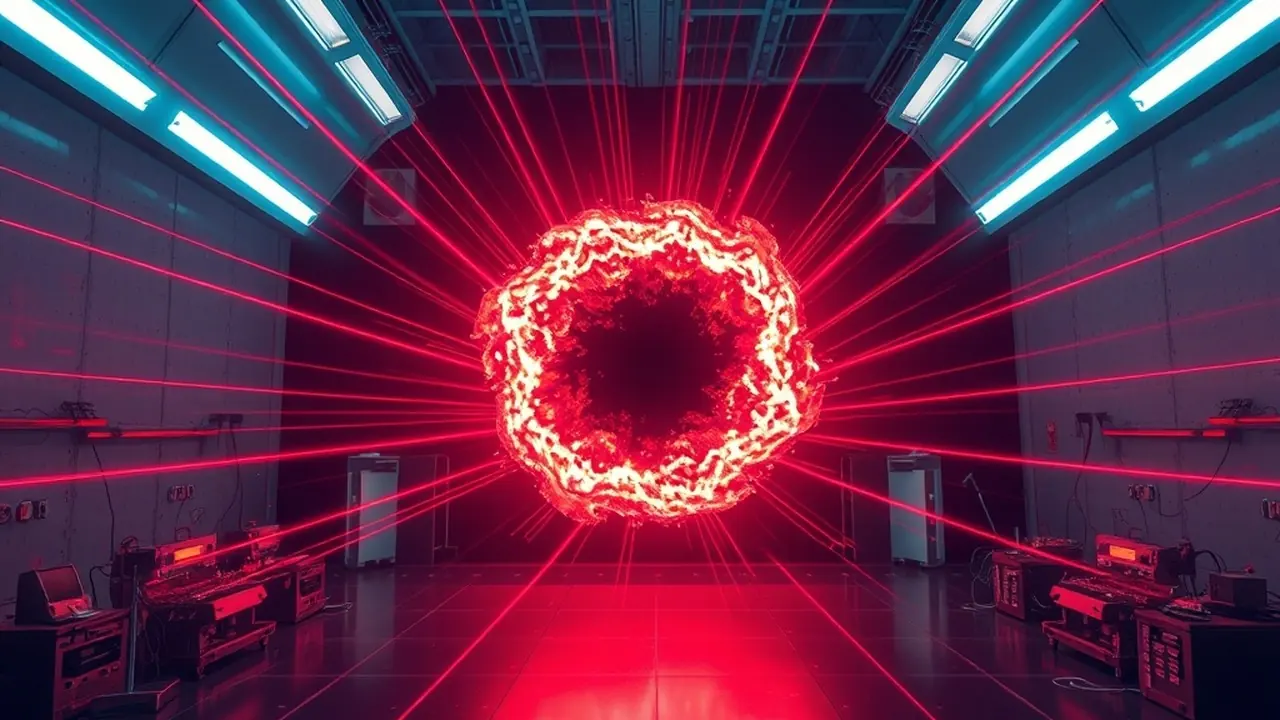
David Weld and colleagues at the University of California, Santa Barbara published in Physical Review Letters an experiment in which a matter-wave cavity behaves like the surroundings of a black hole (and its hypothetical opposite, a white hole). Phys.org covered it on November 6, 2026.
In a classical optical cavity, if a mirror vibrated at the light’s round-trip rate, theory predicts waves would pile into a short pulse flowing one way, analogous to light near a horizon. That vibration would need impossible accelerations. The team cooled lithium near absolute zero, trapped it in a laser lattice so it moved below 1 m/s as a matter wave, and used two light sheets as “mirrors”; one oscillated about 100 times per second.
Within a few cycles the cloud concentrated into a packet on a stable path; others converged on the same one-way trajectory. Doubling the frequency made two packets; shifting the phase reversed the flow. The effect could compress optical signals and help explore photon-pair creation between accelerating mirrors.
Key facts
- Published in Physical Review Letters (Tanlimco et al., 2026); UC Santa Barbara.
- Matter-wave Fabry-Pérot cavity with a light “mirror” driven at ~100 Hz.
- Confirms unidirectional flow analogous to black-/white-hole horizons.
- Possible route to compress optical signals without mechanical mirrors.
When the lab mimics spacetime geometry, extreme physics leaves the telescope and arrives on the optical bench.
Futurismo newsletter
Get the most futuristic stories in your inbox. Free.
By subscribing you agree to receive emails from Futurismo and our privacy policy. Unsubscribe anytime.Related stories
A theorem strengthens the case that the universe had a beginning
Raphael Bousso extends a singularity theorem into the quantum realm.
The coldest temperature ever measured is born in orbit
On Tiangong station, rubidium atoms reached 9.7 picokelvin, four times colder than the previous record.

The battery that stores energy with CO2 instead of lithium
An Italian company stores solar electricity by compressing carbon dioxide.
Martian dust is gentler than lunar dust, but it has risks
Spacesuit samples aboard Perseverance barely wore down over 1,645 Martian days.