A robot builds a structure in space for the first time
Caltech’s ASTRA demonstrator, under DARPA’s NOM4D program, assembled an antenna bay in orbit without astronauts.
Until now, large space structures were folded on Earth or put together by hand. An autonomous arm has just shown a third path: building them up there.
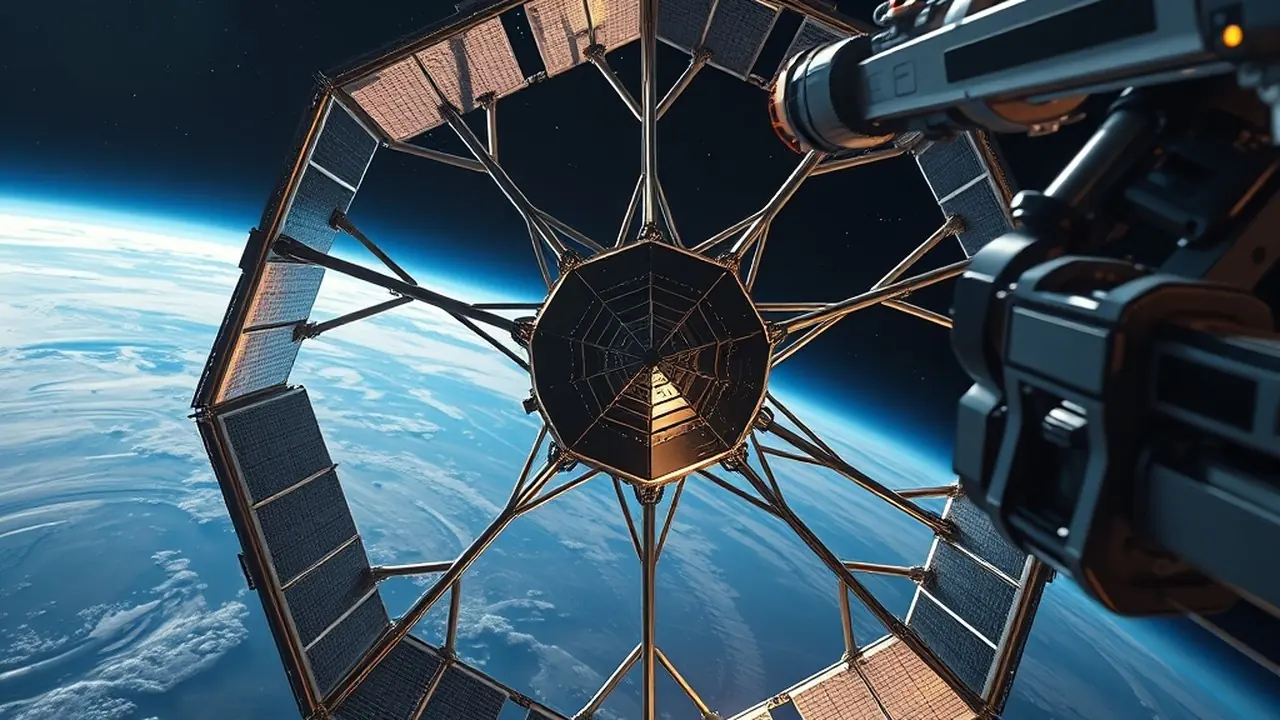
Caltech researchers led by Sergio Pellegrino announced on November 6, 2026 that their ASTRA (Autonomous In-Space Tensioned Reflector Assembly) truss builder assembled in low Earth orbit a section of a 1.4-meter-diameter reflector antenna. It is, the team says, the first time a structure has been autonomously constructed in space. The work is part of DARPA’s NOM4D program.
ASTRA rode to orbit on March 30, 2026 aboard Momentus’s Vigoride 7 vehicle, launched on SpaceX’s Transporter-16 mission. The roughly one-cubic-meter payload carried two prebuilt bays, a manipulator, dispensers of composite-fiber tubes and aluminum joints, and a perforated Kapton reflective surface. After release of launch restraints, the arm built a third bay in orbit; time limits kept the team from finishing all 11 planned bays, but enough to validate the concept.
Antenna and telescope apertures already outgrow rocket fairings. Building in place opens the door to hundred-meter-scale reflectors for astronomy, communications and space solar power. The team says the approach is viable and that the design must be simplified.
Key facts
- First autonomous construction of a structure in space (Caltech / DARPA NOM4D).
- 1.4 m reflector antenna; ~1 m³ payload on Vigoride 7 (launch March 30, 2026).
- Third bay assembled in orbit; mission ends in December 2026.
- Perforated Kapton reflector co-developed with the University of Pennsylvania.
If orbital factories begin with a single truss bay, the next step is thinking about stadium-sized antennas.
Futurismo newsletter
Get the most futuristic stories in your inbox. Free.
By subscribing you agree to receive emails from Futurismo and our privacy policy. Unsubscribe anytime.Related stories
Skyscrapers that work as gravity batteries
Energy Vault and SOM propose storing energy by raising and lowering weights inside towers.
A theorem strengthens the case that the universe had a beginning
Raphael Bousso extends a singularity theorem into the quantum realm.
The coldest temperature ever measured is born in orbit
On Tiangong station, rubidium atoms reached 9.7 picokelvin, four times colder than the previous record.
The battery that stores energy with CO2 instead of lithium
An Italian company stores solar electricity by compressing carbon dioxide.