DNA that recognizes shape, not just sequence
Two-layer aptamers detect small molecules such as serotonin with a lateral-flow test visible to the naked eye.
Home pregnancy or COVID tests work because the target is large: two antibodies fit. Tiny molecules such as serotonin do not. A new DNA trick solves that.
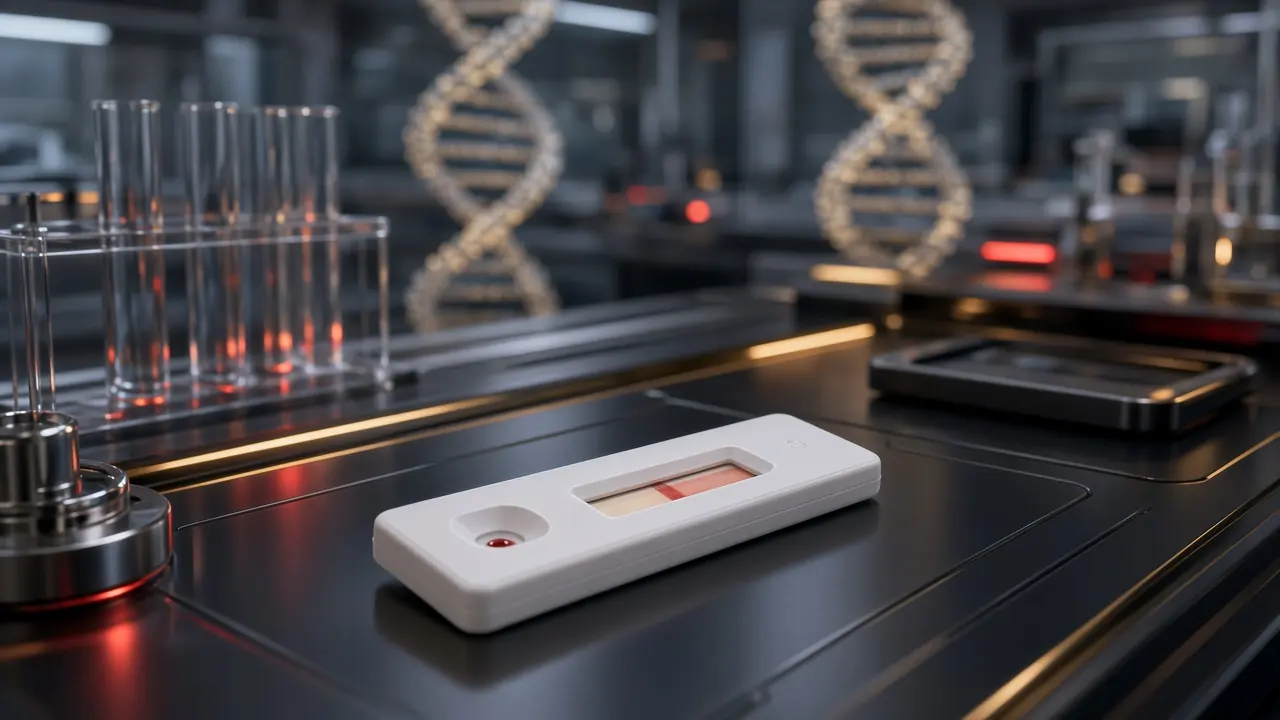
The CHEMINA lab at EPFL in Switzerland published in Nature Chemistry a method in which a primary aptamer captures the target molecule and a secondary aptamer recognizes the three-dimensional shape that first strand adopts when bound—not the sequence or the molecule itself. Phys.org reported it on November 5, 2026.
The team used known aptamers for serotonin, dopamine, testosterone and a steroid (DOG). After screening billions of sequences, they found useful secondaries for serotonin, testosterone and DOG, and confirmed they bind only when the primary has already trapped its target. As a proof of concept, they built a serotonin lateral-flow test with a result visible by eye.
Until now, a single aptamer had to both recognize and signal, often needing fluorescence or electrical gear. Splitting those jobs opens simpler sensors and, longer term, layers of molecular logic where each binding acts like a switch. The team is refining sensitivity and the puzzle of why no dopamine secondary appeared.
Key facts
- Published in Nature Chemistry (DOI 10.1038/s41557-026-02286-4).
- Two layers: primary aptamer plus secondary that reads its bound shape.
- Serotonin lateral-flow test visible without instruments.
- Secondaries found for serotonin, testosterone and DOG; not for dopamine.
Teaching DNA to “see” shapes, not only letters, brings small-molecule tests closer to the pocket.
Futurismo newsletter
Get the most futuristic stories in your inbox. Free.
By subscribing you agree to receive emails from Futurismo and our privacy policy. Unsubscribe anytime.Related stories

An AI designs proteins from a simple text description
The Pinal model turns a sentence into a candidate protein, although its hit rate is still uneven.

The coldest temperature ever measured is born in orbit
On Tiangong station, rubidium atoms reached 9.7 picokelvin, four times colder than the previous record.
A moth robot grows a sensor from its own blood
Tartu and IIT engineers make a 3D-printed robot fabricate a UV detector wherever light shines.

NASA trains autonomous landings for the Moon and Mars
The SPLICE system, aboard an Alta-X drone, maps terrain and diverts descent if rocks or slopes look unsafe.